

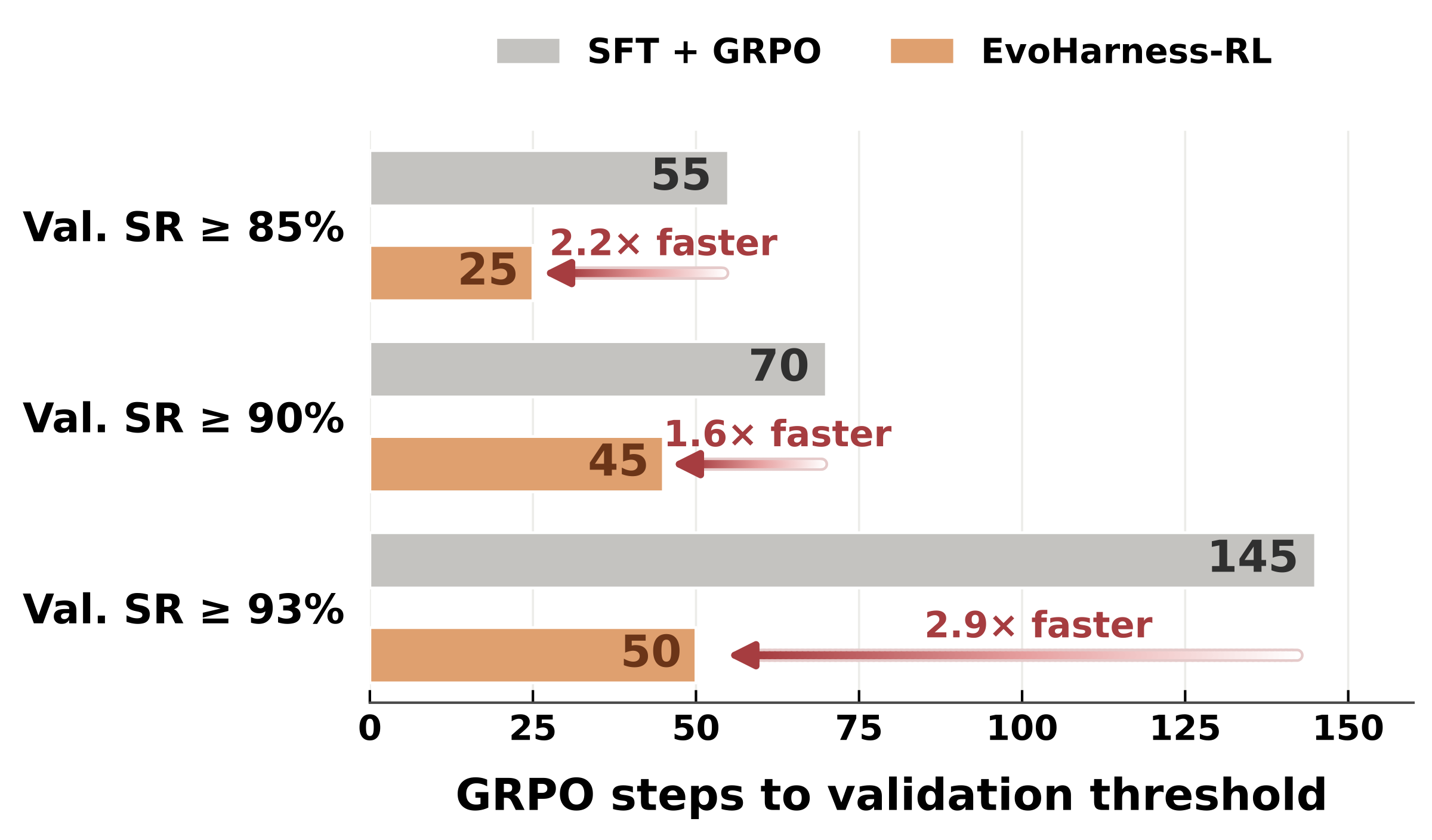
The scaffold makes GRPO rollout-efficient
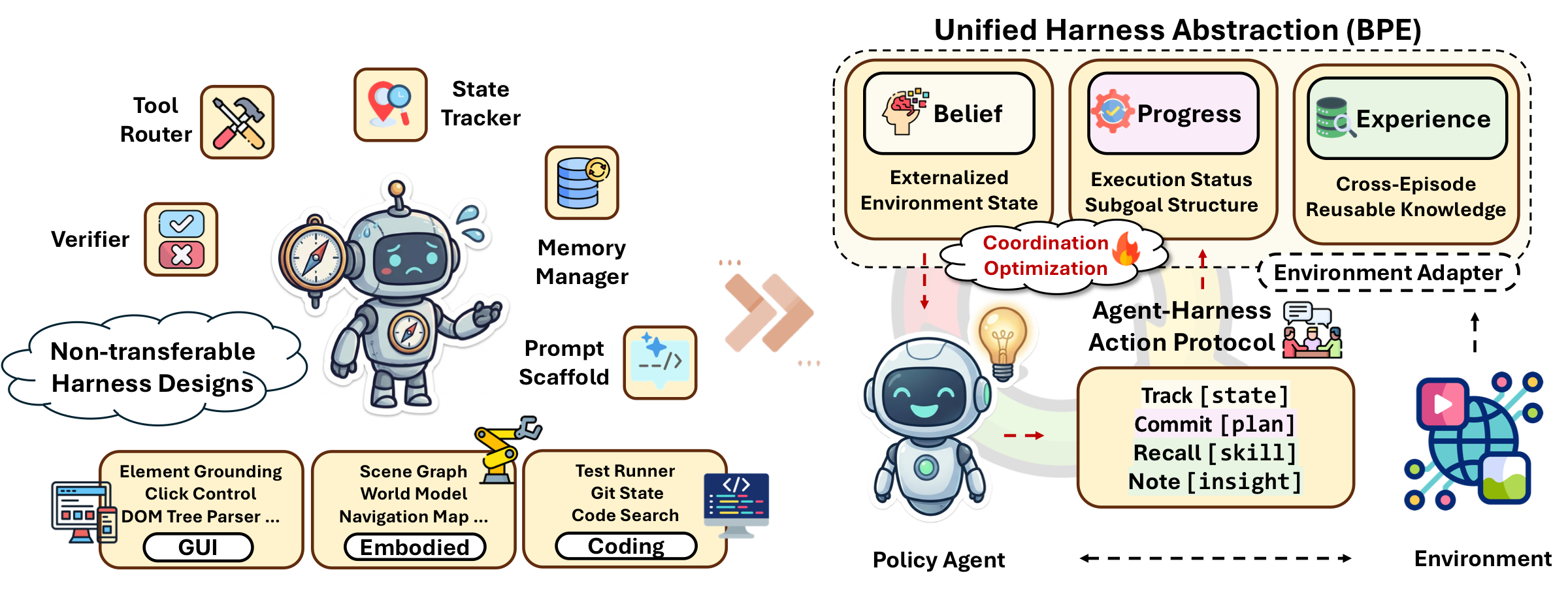
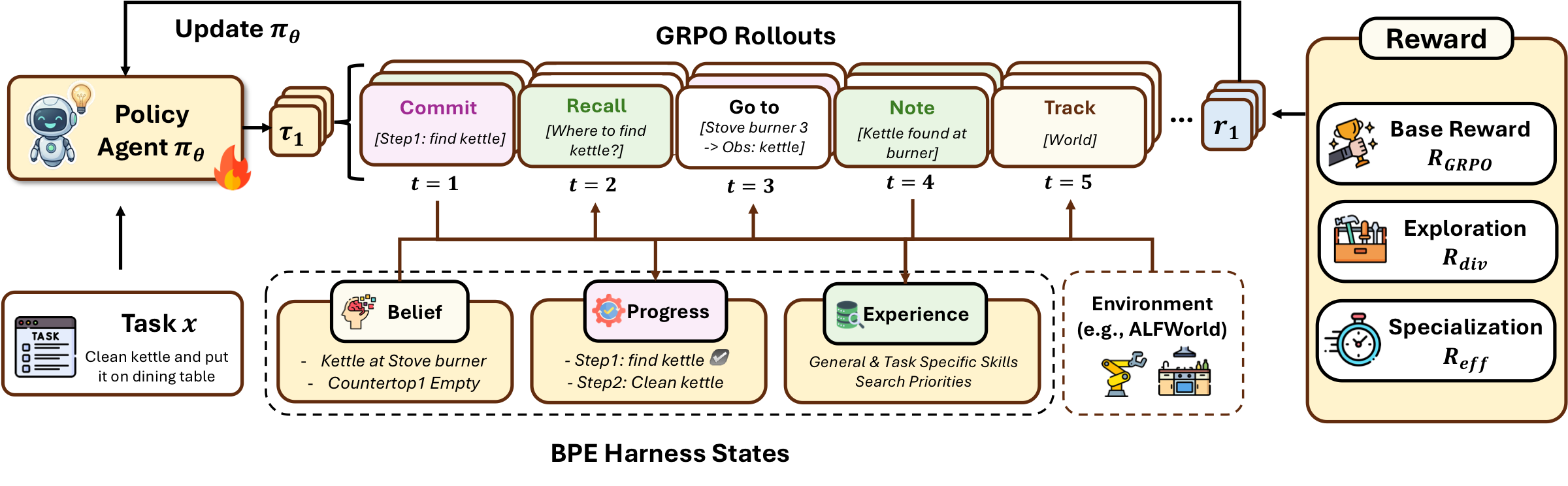
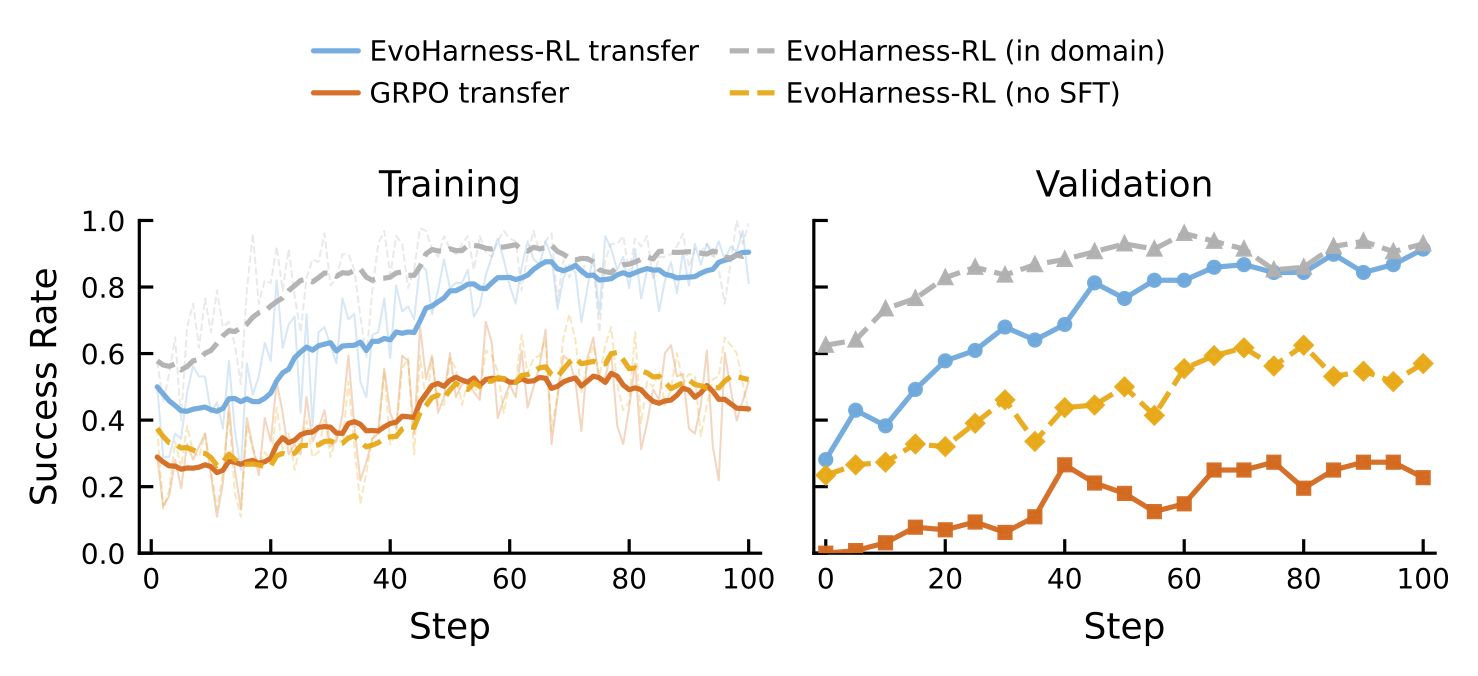
Externalized state, progress, and experience let GRPO discover successful trajectories earlier, so each rollout batch carries more learning signal.
- Same supervised-data budget: reaches 85 / 90 / 93% validation success in 2.2× / 1.6× / 2.9× fewer GRPO steps than vanilla SFT + GRPO.
- It starts lower (57.8 vs. 79.7%) — it must also learn four new actions — then overtakes. The gain is not from a stronger SFT checkpoint.
- Versus plain GRPO: hits 80% training success by step 19 and averages ~23 pts higher over the last 10 steps.
Why: conditional rollout-efficiency bound
If BPE returns decision-relevant information used with bounded error, the rollouts needed to find a success with prob. $\ge 1-\rho$ satisfy
$$N_{\mathrm{BPE}}(x) \le \Bigl\lceil \tfrac{1}{1+\alpha(x)/p_0(x)}\, N_{\mathrm{base}}(x)\Bigr\rceil,$$where $p_0$ is the baseline success probability and $\alpha>0$ the net benefit of BPE information — largest when $p_0$ is small.
 trainable;
blue = column best per backbone; shaded rows = ours; Δ averages the four aggregate-metric gains over paired ReAct;
† ALFWorld/WebShop numbers transcribed from SkillOS.
trainable;
blue = column best per backbone; shaded rows = ours; Δ averages the four aggregate-metric gains over paired ReAct;
† ALFWorld/WebShop numbers transcribed from SkillOS.